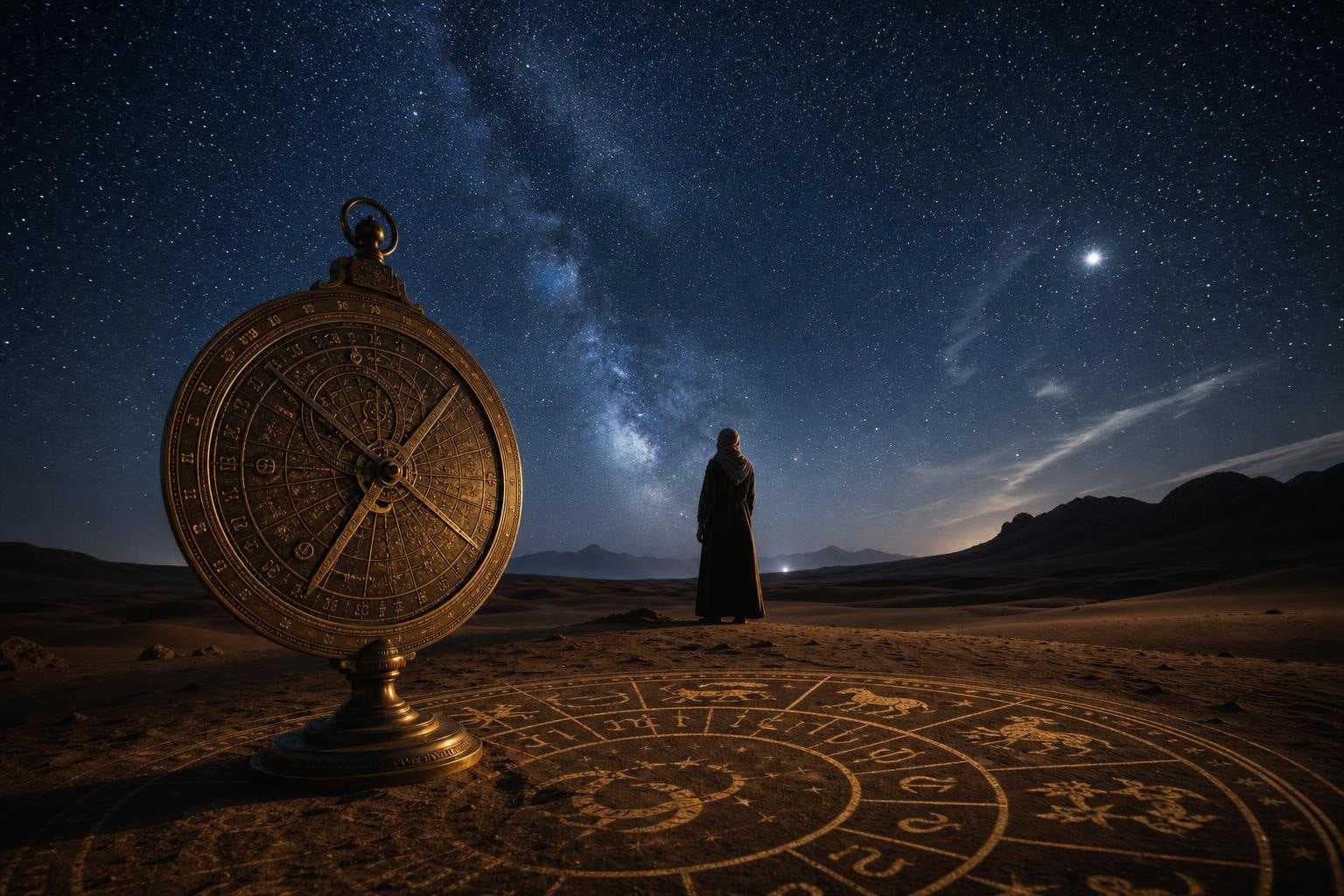
Your Zodiac Sign Might Be Off by One: The 2,000-Year-Old Sky Drift Astrologers Don't Mention Is More
April 30, 2026
You open an app, see a viral post saying the stars moved, and suddenly everyone is yelling, "I am not a Leo anymore!" Cue the existential crisis, the screenshot carousel, and one friend declaring their entire personality has been reassigned to Cancer.
Here is the cosmic tea: the sky really has shifted relative to the zodiac signs over roughly 2,000 years. But the claim that astrologers do not mention it is not quite right. It is one of the biggest, oldest, and most openly discussed differences between Western tropical astrology and Vedic sidereal astrology.
The plot twist is not that astrology forgot astronomy. It is that different astrological systems deliberately measure the zodiac from different starting points.
The Sky Drift Is Real, and It Has a Name
Earth wobbles very slowly on its axis, like a spinning top that refuses to quit the party. That motion is called precession, and it gradually changes where the equinox points toward the background constellations. Over about two millennia, the shift adds up to nearly one zodiac sign, or about 28 degrees.
This is why a person born when the Sun is called Aries in most newspaper horoscopes may find that the Sun sits in Pisces when calculated in a Vedic or sidereal chart. The word sidereal means star-based. It uses the positions of the planets against the stellar backdrop, then applies a correction called ayanamsha, meaning the measured difference between the tropical and sidereal zodiacs.
To compare the sky drift in your own placements, run a free horoscope and note the sidereal Sun, Moon, and Rising beside the tropical ones.
That is not a glitch. It is the whole system.
Think of it like two maps of the same city. One labels streets by an old neighborhood grid; the other uses current satellite coordinates. Both can be useful, but you need to know which map your coffee shop is using before you accuse it of being lost.
Tropical and Sidereal Astrology Are Playing Different Games
Most popular Western astrology is tropical astrology. Its zodiac begins at 0 degrees Aries at the March equinox, when day and night are approximately equal. In this system, Aries is tied to the seasonal ignition point of spring in the Northern Hemisphere, not to the modern location of the Aries constellation.
Vedic astrology, also called Jyotish, generally uses the sidereal zodiac. Jyotish translates to "the science of light," and it is especially focused on planetary timing, lunar placements, and practical life patterns. It anchors signs more closely to the visible stars, which is why its sign placements often land one sign earlier than tropical placements.
So, if you are a tropical Gemini Sun, you may be a sidereal Taurus Sun. But that does not mean your old reading was a lie and your new one is a cosmic witness-protection program. It means you have switched coordinate systems.
Your Sun sign is only one note; Moon, Rising, and the rest form the full chord.
That line matters extra hard here. A birth chart is not a one-sign personality quiz wearing celestial eyeliner. Your Moon describes emotional instincts. Your Rising sign, also called the ascendant, reflects the sign rising on the eastern horizon at birth and sets up the houses, or life areas, of the chart. Mercury, Venus, Mars, and the timing techniques all add layers.
Translation: learning you are a sidereal Taurus Sun does not automatically erase the loud, quick, curious way your tropical Gemini Sun meme folder feels strangely accurate.
Why the "Everyone Is the Wrong Sign" Take Goes Viral
The internet loves a plot twist with a clean before-and-after slide. "Your zodiac sign is wrong" is clickier than "Two long-standing symbolic systems use distinct reference points and produce different interpretive frameworks." One fits on a TikTok graphic. The other sounds like a syllabus, although it is much closer to the truth.
There is another source of confusion: constellations and zodiac signs are not identical things. Astronomical constellations have uneven boundaries and sizes. Astrological signs divide the zodiac into twelve equal 30-degree sections. The Sun also passes through part of Ophiuchus, a constellation sometimes branded the secret 13th zodiac sign. But Ophiuchus is not an overlooked 13th sign inside the traditional twelve-sign astrological framework.
In other words, NASA can describe where the Sun appears among constellations, while astrology describes a symbolic zodiac system. Those are related conversations, not the same conversation. Trying to make them fight is a little like asking a weather map to explain your Spotify Wrapped.
What Vedic Astrology Adds to the Conversation
Vedic astrology does not stop at the twelve signs. It also uses 27 nakshatras, or lunar mansions: star-based segments of the zodiac that add fine-grained texture, especially for the Moon. If signs are broad musical genres, nakshatras are the niche playlists that somehow know you enjoy sad synth-pop during a full moon.
For example, two people can both have a sidereal Moon in Taurus but occupy different nakshatras, giving their emotional style distinct flavor. One may seek stability through comfort and caretaking; another may crave beauty, creativity, or devotion. The sign tells part of the story. The lunar mansion zooms in.
Vedic practice also uses dasha, or planetary-period timing. A dasha system asks which planet is taking the lead in a particular chapter of life. This is where astrology gets less "you are such a Virgo" and more "why did career, home, and identity all start changing at once last autumn?"
That said, no chart should be used as a permission slip for fatalism. Planets can describe weather, seasons, tendencies, and timing. They do not replace your choices, your boundaries, your budget, or a good night's sleep.
So Which Sign Should You Claim?
Claim the system you are using, with the label attached. If you read tropical astrology, your tropical Sun sign is valid within that tradition. If you study Vedic astrology, calculate your sidereal chart and explore that framework on its own terms. You do not need to stage a breakup between them.
A practical way to compare them is to notice what each system emphasizes. Tropical astrology can be wonderfully revealing for inner identity, archetype, and psychological patterning. Vedic astrology can offer a detailed lens for houses, lunar mansions, planetary dignity, and time periods. Some people treat them as separate languages; others enjoy learning both without forcing them to agree word for word.
The least useful move is declaring that a single Sun-sign swap settles every question about who you are. Nobody becomes a different person because a calculator finally showed them a different zodiac reference point. You were already carrying your whole chart, your lived experience, and your wonderfully complicated human plotline.
Try This Instead of Panic-Posting
-
Pull both a tropical and sidereal birth chart using your exact birth time and birthplace. Compare your Sun, Moon, and Rising signs first. Journal: Which descriptions feel familiar, and which reveal a side of me I have not named yet?
-
Find your sidereal Moon nakshatra, or lunar mansion, and read about its themes. Then ask: What emotional habit do I want to keep, and what response pattern is ready for an upgrade?
-
Make it a mini cosmic ritual: light a candle, put your phone on do-not-disturb, and write one sentence beginning, "I am more than one label because..." Precession may move the celestial reference points, but self-knowledge is still an active practice, not a personality hand-me-down.
No one can be defined by just one sign.
See for yourself, with a free horoscope.
Generate a Horoscope