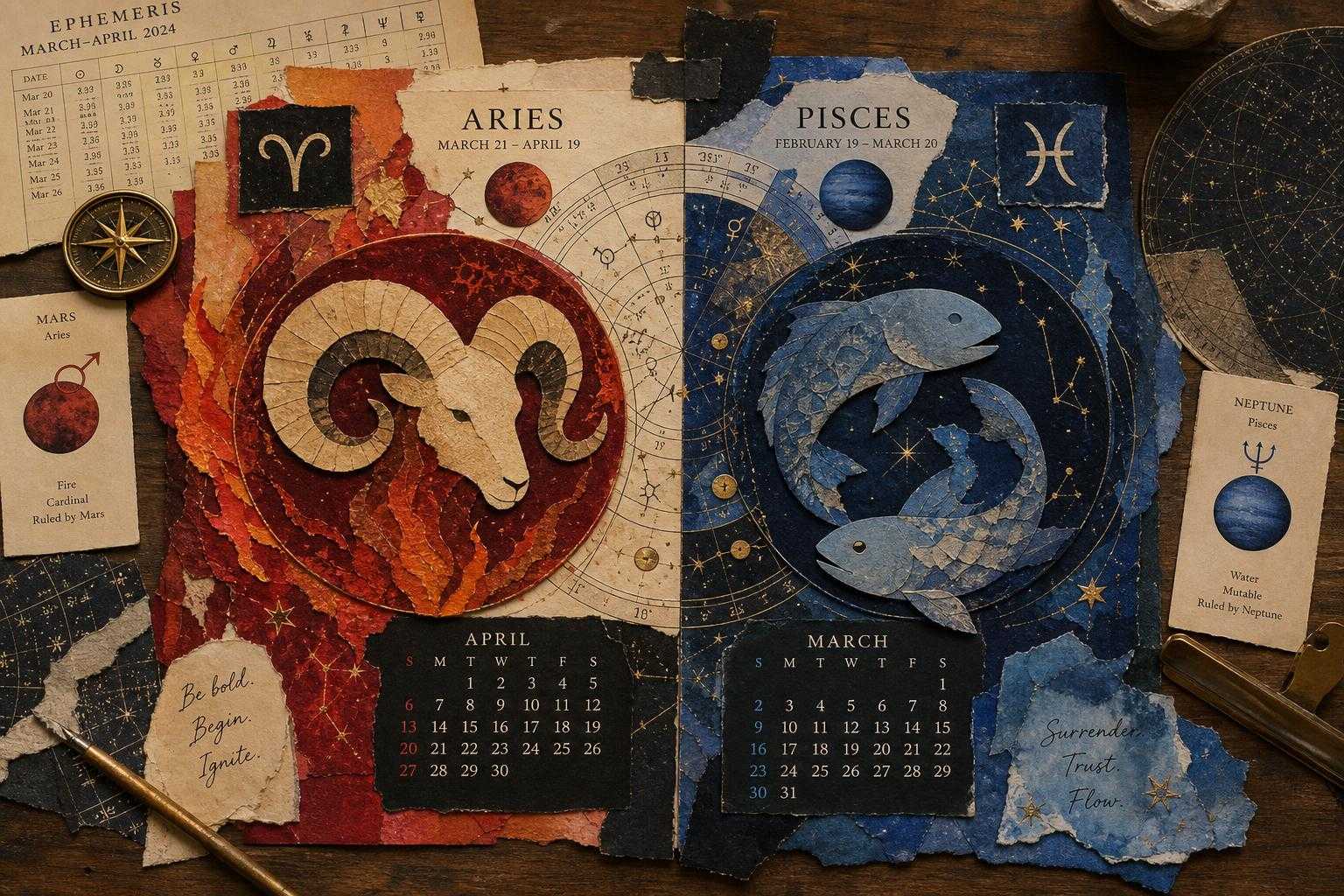
Tropical Says Aries, Sidereal Says Pisces: Why Your 2026 Transit Dates Look Different Everywhere.
May 29, 2026
Your 2026 transit calendar is not gaslighting you. If one astrologer posts, "Saturn is in Aries," while your Vedic app calmly serves "Saturn is in Pisces," both may be working from the same sky and arriving at different sign labels.
Welcome to the tropical-versus-sidereal split: astrology's most enduring group-chat debate, with more moving parts than a season finale and just as many screenshots. The short version is simple: tropical astrology measures the zodiac from the seasonal March equinox, while sidereal astrology measures from a star-referenced zodiac. Because those starting points no longer line up, a planet can wear a different cosmic jersey in each system.
Two Zodiacs, One Planetary Sky
Think of the zodiac as a 360-degree wheel divided into twelve equal 30-degree signs. Both systems use that wheel. The big difference is where they place the zero point.
Tropical astrology, the framework used in much of modern Western astrology, always begins Aries at the March equinox. This makes tropical Aries the seasonal spark: launch energy, spring fever, fresh-start confidence, and the emotional urge to buy a new notebook and become a new person by Tuesday.
Sidereal astrology, the foundation for most Jyotish, or Vedic astrology, uses a zodiac aligned to a stellar reference point. It adjusts for precession, the slow long-term wobble of Earth's axis that changes the equinox's position relative to the star background. In common Indian practice, that adjustment is called an ayanamsha, meaning "the portion of movement." Lahiri ayanamsha is a widely used setting.
In practical 2026 terms, the sidereal zodiac sits roughly 24 degrees behind the tropical zodiac. So a planet at tropical 0 Aries will often still be in late sidereal Pisces. Same planet. Same astronomical longitude. Different cosmic map pin.
If the split keeps confusing your 2026 calendar, create a free horoscope and check which zodiac setting your chart is using before comparing transit dates.
Here is the vibe in chart-snippet form:
Tropical: 0 Aries = seasonal reset point Sidereal: 0 Aries = star-referenced reset point
A planet at tropical 0 Aries may read as sidereal late Pisces.
That is why "Aries season" and "sidereal Aries" do not necessarily begin together. It is not an astrology error message. It is a coordinate-system choice.
Why 2026 Transit Dates Can Be So Different
Transit dates are the moments a moving planet crosses from one sign into another. If tropical and sidereal signs begin about 24 degrees apart, their ingress dates will also be separated. For the Sun, which moves about one degree a day, the gap can look close to three-plus weeks. For Mercury, Venus, Mars, Jupiter, Saturn, and the outer planets, the timing difference can stretch, shrink, or get delightfully weird depending on speed and retrograde motion.
That last word matters. Retrograde means a planet appears to move backward from Earth's perspective. When a planet is hovering near a sign boundary, it may cross it, reverse back over it, and cross again later. Tropical and sidereal calendars can therefore seem to tell completely different stories about when a chapter starts, pauses, or returns for the remix.
A 2026 example in plain language: if a slow planet enters tropical Aries, it may remain sidereal Pisces for quite a while. Tropical readers may frame the transit as initiative, leadership, heat, and taking the wheel. Sidereal readers may first explore Pisces themes: closure, surrender, imagination, spiritual cleanup, sleep, oceans, art, and the mysterious drawer full of old chargers. Neither reading needs to cancel the other. They are emphasizing different symbolic thresholds.
This is the astrology version of two camera angles at the same concert. One catches the drummer. One catches the crowd crying during the bridge. Same song; different information.
The Secret Extra Setting: Ayanamsha
Not all sidereal charts agree with one another either. Enter ayanamsha, the calculation used to define the offset between tropical and sidereal zodiacs. Lahiri is common in Vedic astrology, but other ayanamshas exist, including Raman, Krishnamurti, and Fagan-Bradley.
That means two sidereal apps can occasionally give slightly different ingress times or even different sign results when a planet is very close to a cusp, the boundary between signs. If you have ever wondered why your friend's app says the Moon changed signs at 2:14 p.m. while yours says 3:01 p.m., this is a prime suspect.
Then add time zone, location, ephemeris settings, and whether an app rounds positions. Suddenly the internet has twelve versions of the same transit and everyone is holding a ring light over their birth chart. Very "this is fine" dog meme, but celestial.
Houses Make the Story Personal
A sign transit is the weather report. Houses tell you which room of your life gets the weather.
In Vedic astrology, houses are called bhavas, meaning areas or fields of experience. A sidereal Pisces transit could land in a very different house than a tropical Aries transit, depending on the house system and chart framework being used. One astrologer may see a planet activating your career zone; another may see it stirring your friendships, home life, or inner world.
This is why copying a transit headline from social media can feel like wearing someone else's prescription glasses. The sign is only one layer. Your rising sign, also called the ascendant, anchors the house layout; your Moon sign describes emotional timing; and in Jyotish, nakshatras, or lunar mansions, add an even finer 27-part layer to the Moon and planet story.
Your Sun sign is only one note; Moon, Rising, and the rest form the full chord.
For Vedic chart readers, 2026 transits can also be filtered through dasha, a planetary timing period that describes which natal planet is holding the microphone in a given life chapter. A big Jupiter or Saturn transit may be louder if it connects with your active dasha. Translation: the transit is the incoming call; the dasha tells you why you feel compelled to answer.
So Which System Is Right?
The most useful answer is: right for what question, and consistent with what tradition?
Tropical astrology is especially fluent in seasonal symbolism and is often used for psychological and archetypal readings. Sidereal Vedic astrology is deeply connected to nakshatras, dashas, remedies, and predictive techniques. They are not interchangeable spreadsheets, and mashing their rules together without labeling the settings can create more confusion than clarity.
Try not to treat the result as a cosmic personality cage match. Tropical Aries and sidereal Pisces can describe a compelling 2026 threshold: a visible push toward action alongside a private need to release what is finished. Start the project, yes. Also delete the folder named "FINAL_final_reallyfinal." Both are sacred.
How to Read 2026 Transits Without Losing the Plot
First, check the label on every transit post: tropical or sidereal? If it says sidereal, look for the ayanamsha too, especially if the date feels close or consequential.
Second, use one system consistently for a full transit experiment. Track a month of tropical transits in one column and sidereal transits in another. Note events, moods, decisions, and recurring themes. Your lived pattern beats a panic-scroll.
Third, remember that dates are doors, not verdicts. An ingress can describe a shift in tone, but it does not force an outcome. You still have agency, snacks, boundaries, and the power to decline a meeting that should have been an email.
Three Cosmic Coach Takeaways
-
Journal prompt: When tropical Aries energy says "go," what does sidereal Pisces ask you to complete, forgive, or release first?
-
Calendar ritual: Put your preferred 2026 transit dates on one calendar, then mark the alternate system in a different color. Watch where the two timelines echo rather than compete.
-
Tiny remedy: On a confusing transit day, spend ten quiet minutes near water, take three intentional breaths, and write one practical next step. Pisces gets the spacious exhale; Aries gets the move-your-feet follow-through.
Your chart does not need one app to win the argument. It needs you to know which celestial language you are reading, then use it with curiosity, discernment, and a little stardust on the spreadsheet.
No one can be defined by just one sign.
See for yourself, with a free horoscope.
Generate a Horoscope