The Indian Astrology Test: Enter Your Birth Details and Watch Your Entire Personality Change in Real
July 10, 2026
The Indian Astrology Test has the kind of premise that makes the internet sit up straighter: enter your birth date, time, and place, then watch a cosmic profile of your temperament, relationships, work style, fears, talents, and oddly specific emotional habits appear on screen. Suddenly, the person who thought they were just a standard-issue Leo discovers a practical Virgo Moon, a mysterious Scorpio Rising, and enough inner contradictions to qualify for a season finale.
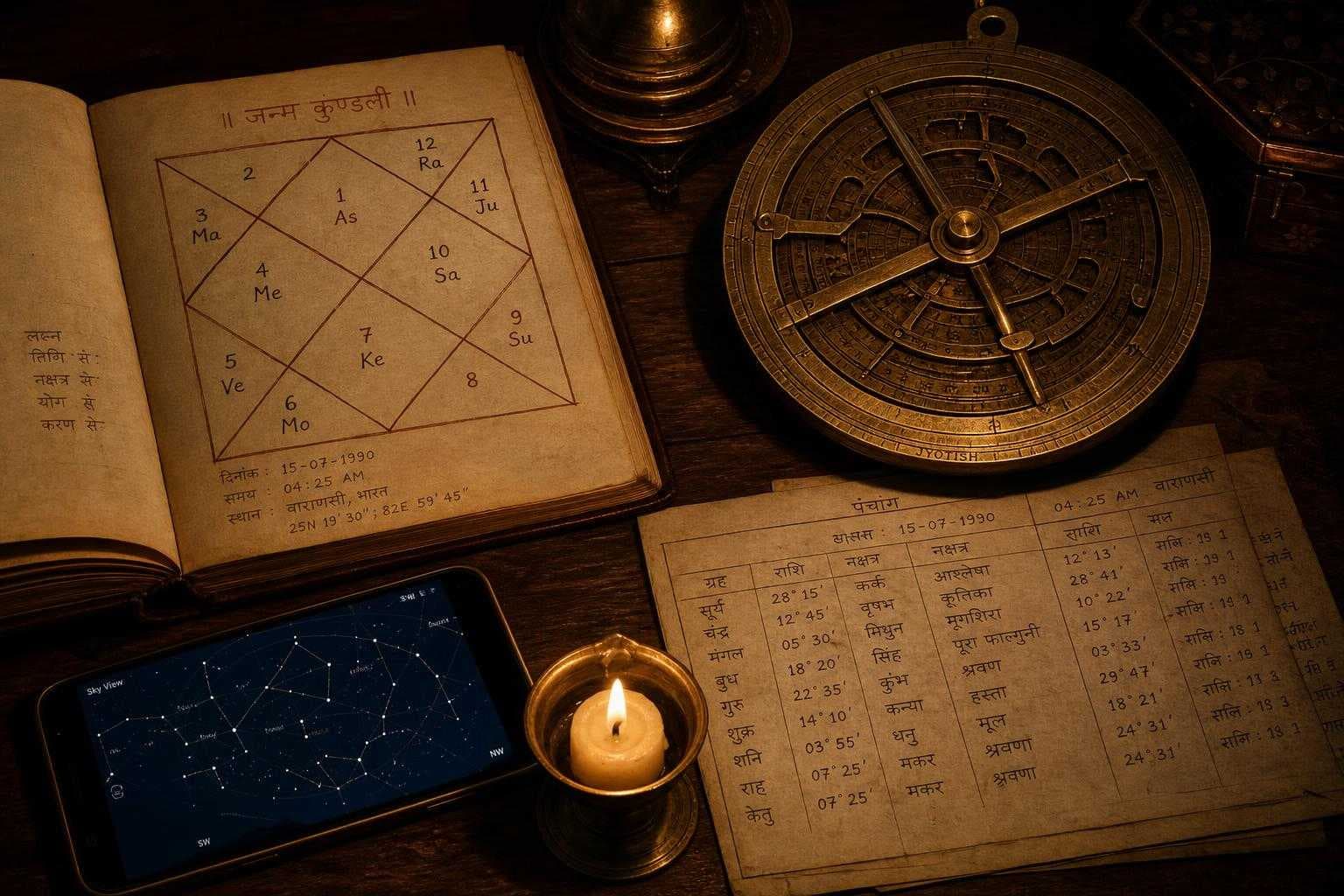
But does your entire personality actually change? Not exactly. The test changes the lens. In Vedic astrology, also called Jyotish or the "science of light," your birth details create a map of the sky at the moment you arrived. That map is less like a personality label and more like a multi-tab browser: identity, feelings, public vibe, family patterns, romance, ambition, money instincts, and the reasons you can send a perfectly composed email while internally screaming into the void.
Why Birth Time Is the Plot Twist
A birthday alone can give a broad Sun-sign reading. Your exact birth time is where The Indian Astrology Test gets interesting. It determines your Ascendant, also called the Rising sign or Lagna. The Ascendant is the zodiac sign rising on the eastern horizon at birth, and it sets the order of the twelve houses in a Vedic chart.
Think of the houses as rooms in your cosmic apartment. The first house is your body, presence, and instinctive approach to life. The second covers speech, savings, and family values. The seventh is partnership territory. The tenth is career, reputation, and the kind of achievement that makes your LinkedIn quietly glow. Each planet lands somewhere, and suddenly the reading has actual architecture.
If you want to test that birth-time plot twist on your own chart, enter your details for a free horoscope and compare the Ascendant with the houses it creates.
A person with a bold Aries Sun can come across very differently with a diplomatic Libra Rising or a reserved Capricorn Rising. Same solar engine, different dashboard. That is why two people born under the same Sun sign can feel as alike as two group-chat members who both say "we should plan something" and mean wildly different things.
Your Sun sign is only one note; Moon, Rising, and the rest form the full chord.
The Moon Sign Is Where the Feelings Keep Receipts
In Vedic astrology, the Moon often takes center stage because it describes the mind, emotional habits, comfort needs, and everyday reactions. If the Sun is the role you are learning to inhabit, the Moon is the inner weather report.
Say you have a fiery Sun but a water-sign Moon. You may look decisive, funny, and ready to launch the plan, yet privately need reassurance, quiet time, or a playlist dramatic enough to earn an Oscar. A Moon in Taurus may seek steadiness, quality snacks, and sensory peace. A Moon in Aquarius may process emotions through ideas, communities, and an urgent need to figure out why everyone is being so weird.
Then come the nakshatras, the lunar mansions. These are 27 sections of the zodiac used in Vedic astrology to add texture to the Moon and planets. If signs are neighborhoods, nakshatras are the particular street: the atmosphere, the backstory, the signature move. A person can share a Moon sign with someone else but have a very different nakshatra flavor, which is why a good Indian astrology test may feel more nuanced than a quick horoscope meme.
Planets Do Not Hand You a Personality; They Describe Your Patterns
The fun of a Vedic chart is watching the planets play their roles. Mercury shows communication and problem-solving. Venus points to attraction, pleasure, aesthetics, and what you value. Mars describes drive, heat, conflict style, and your relationship to action. Jupiter speaks to growth, meaning, learning, and generosity. Saturn brings responsibility, boundaries, and the places where patience becomes your unexpected superpower.
And yes, Rahu and Ketu often make a guest appearance with major main-character energy. They are the lunar nodes, mathematical points where the paths of the Sun and Moon intersect. Rahu can describe hunger, experimentation, and the places where you may chase "more." Ketu can describe old familiarity, detachment, and instincts that come so naturally you might overlook their value.
This is not a cosmic sentence handed down by a celestial judge wearing sequins. It is a language for patterns. A strong Mars does not mean "you will fight everyone at brunch." It can mean you are brave, direct, competitive, protective, or especially energized when there is something tangible to build. Saturn does not mean doom. It may mean that your biggest rewards ripen through consistency rather than instant applause. Very "trust the process," but with better planets.
Why It Feels Like Your Personality Is Changing
When people say an Indian astrology test changed their personality, what often changed was self-recognition. Maybe the report gave words to the part of you that needs both independence and closeness. Maybe it explained why your work life matters deeply but traditional career ladders feel itchy. Maybe it reminded you that being sensitive is not the opposite of being capable.
There is also the timing layer: daśās, or planetary periods. Vedic astrology uses systems of planetary cycles to explore which themes may feel louder during different chapters of life. A Venus period might highlight relationships, creativity, values, or enjoyment. A Saturn period might emphasize structure, responsibility, long-range goals, and learning to stop treating rest like a reward you have to earn.
Timing techniques are best used as reflection tools, not as a reason to cancel your plans because Mercury looks suspicious. The chart can help you ask better questions: What am I being asked to strengthen? Where am I overdoing control? What kind of opportunity fits my values right now?
How to Take The Indian Astrology Test Without Handing Over Your Free Will
First, use accurate birth details if you can. Birth time matters, and even a small time difference can shift the Rising sign and house placements. If your time is uncertain, treat the result as exploratory rather than gospel.
Second, notice what lands without forcing every sentence to fit. The best readings create useful reflection, not cosmic overfitting. You do not need to claim that every delayed text is Saturn teaching a lesson. Sometimes someone is simply in the shower.
Third, keep it practical. If your chart highlights communication, practice saying what you mean. If it points to restlessness, build a routine that leaves room for novelty. If Venus is a major theme, make beauty and connection part of your real budget, not just your Pinterest board.
The Indian Astrology Test is most powerful when it gives you language for choice. Your chart may describe the ingredients, but you are still the chef. Some days you make a five-course meal; some days it is cereal in a nice bowl. Both are valid expressions of the cosmos.
Three Ways to Use Your Results This Week
-
Journal your cosmic contradiction. Write down your Sun, Moon, and Rising signs, then answer: "Where do these three parts of me cooperate, and where do they argue in the group chat?" Look for patterns, not verdicts.
-
Try a tiny planetary remedy. On Wednesday, Mercury's day, organize one small task, send the message you have been drafting, or learn something new for 20 minutes. Make it useful, not mystical pressure.
-
Create a Moon check-in ritual. Before bed, ask: "What made me feel safe, seen, and emotionally spacious today?" Your Moon sign is not an excuse for chaos; it is a clue to your care instructions.
No one can be defined by just one sign.
See for yourself, with a free horoscope.
Generate a Horoscope