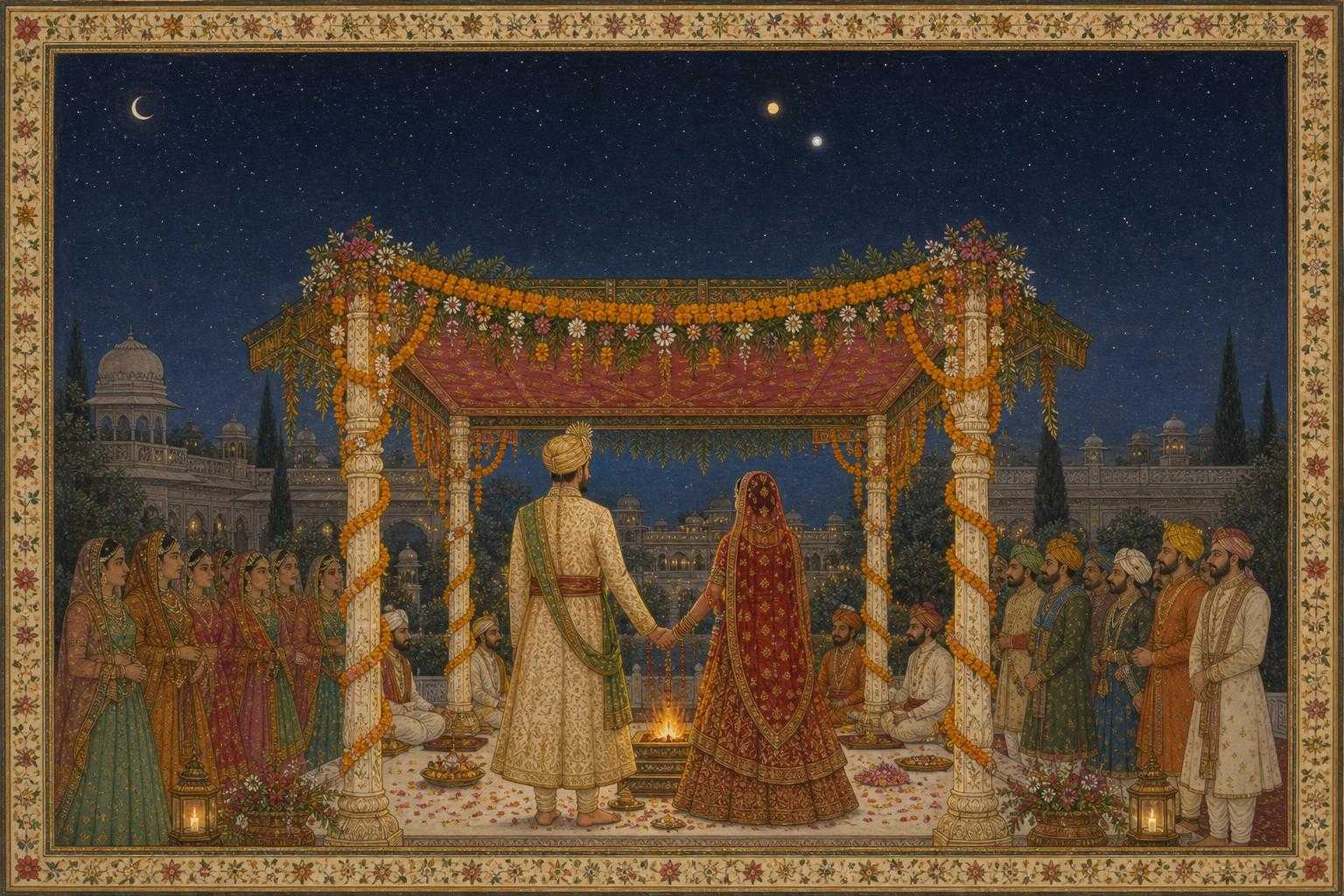
Marriage Muhurta After Guru Asta: The Best Vedic Wedding Dates for Late 2026 and Early 2027.
May 16, 2026
The minute Guru Asta lifts, every family WhatsApp group with a wedding on the horizon tends to become a live-action group project: aunties forwarding panchang screenshots, cousins pricing venues, and one brave soul asking if the date can please, please avoid a Tuesday. Fair. Marriage muhurta is not just calendar admin; it is the cosmic soft launch for a shared life.
Guru Asta means Jupiter combustion: Guru, the planet associated in Jyotish with wisdom, blessings, expansion, teachers, and traditional marriage rites, travels too close to the Sun and is considered astrologically obscured. In 2026, this Guru Asta window runs through mid-July to mid-August. But do not sprint toward an August mandap just because Jupiter has returned to visibility. The larger wedding season still has a few cosmic traffic cones ahead.
The real late-2026 reset
After Guru Asta ends in August, late summer and early fall are still not the cleanest runway for a wedding. Many traditions avoid the Chaturmas period, a four-month devotional season, for major samskaras, or life ceremonies. Then Shukra Asta, the combustion of Venus, adds another pause in October. Venus is the natural relationship significator in Vedic astrology, so a Venus-combust wedding is rather like trying to shoot your rom-com finale with the lights off. Not impossible in life, obviously, but not the preferred ritual timing.
That makes late November the practical re-entry point for many 2026 wedding planners. Think of it as the universe reopening the reservations tab after a very long maintenance window. The vibe is less "we must do this immediately" and more "we have checked the celestial calendar, the caterer is free, and the lehenga has pockets."
For a broad date-level shortlist, the strongest late-2026 options are November 20 and November 25, 2026, followed by December 3, December 4, and December 12, 2026. These are useful anchors for venue scouting, save-the-date conversations, and family logistics. They are not plug-and-play universal ceremony times: the exact muhurta shifts with city, sunrise, local panchang method, and the couple's birth charts.
Why Jupiter matters, but does not work alone
In a marriage muhurta, Jupiter brings the big-picture blessing energy: shared ethics, growth, children if desired, counsel, and the ability to see beyond who forgot to unload the dishwasher. Venus brings affection, pleasure, beauty, and mutual attraction. The Moon sets the emotional weather, while the ascendant, or rising sign at the ceremony, helps frame how the marriage begins its public and practical life.
Then comes Panchanga Shuddhi, meaning the cleanliness or suitability of five calendar factors: tithi, the lunar day; vara, the weekday; nakshatra, the Moon's lunar mansion; yoga, a specific Sun-Moon relationship; and karana, half of a lunar day. A seasoned priest or astrologer can also check lagna shuddhi, the quality of the wedding ascendant, along with the individual charts. That is why two panchangs can agree on a promising date yet offer different ceremony windows.
Before treating a shortlist as final, check the couple's birth details in a free horoscope so the wedding lagna, Moon, and Venus condition are part of the timing conversation.
Your Sun sign is only one note; Moon, Rising, and the rest form the full chord.
The chart snippet version is delightfully simple:
A good date + a supportive local time + two compatible real humans = much better than a pretty date doing all the emotional labor.
No muhurta can replace communication, consent, financial honesty, repair skills, or the sacred art of deciding whose family gets Thanksgiving. Astrology is a timing tool, not a substitute for a relationship operating system.
Early 2027: the winter wedding bench gets deeper
January 2027 begins with a seasonal restriction in many traditions, so the first half is quieter. After mid-January, however, the calendar gets more generous. Practical January contenders include January 15, January 19, January 20, January 24, January 26, January 27, January 30, and January 31, 2027. There can be ultra-short windows on other days, but a date with a tiny ritual opening is not always ideal when you are coordinating photographers, grandparents, airport pickups, and a baraat with main-character energy.
February 2027 offers an especially workable spread: February 3, February 9, February 10, February 11, February 14, February 15, February 21, February 22, February 25, and February 26. If you want a softer, more intimate winter event, these dates provide useful flexibility before spring schedules become packed.
A quick nakshatra note for chart nerds and curious newcomers: several of these windows involve lunar mansions commonly appreciated in marriage election, including Rohini, associated with growth and sensuality; Revati, associated with nourishment and safe passage; Uttara Phalguni, linked to agreements and enduring partnership; Hasta, associated with skillful hands and making a life together; and Anuradha, associated with devotion and friendship. This is not a cosmic Yelp rating for your spouse. It is symbolic texture for the ritual container.
Pick a date without turning into a celestial spreadsheet
Start with the broad dates above, then make a short list based on real-world priorities. Is a Saturday important for guests? Does your venue have an indoor backup plan? Are you blending regional customs that need separate rituals? Is an evening ceremony more meaningful to your families? Great muhurta selection meets reality with kindness.
Next, ask a qualified astrologer or priest to calculate the local time windows for your exact wedding city. A date that looks fabulous in Delhi may open or close differently in Dallas, New Jersey, Seattle, or Toronto because the panchang is tied to local sunrise and lunar timing. If you are matching charts, share both birth details accurately and early; do not hand someone a birth time copied from a family legend after the invitations have gone to print.
Finally, remember that a wedding date should support joy, not manufacture anxiety. The most auspicious thing about a ceremony is still two people who are prepared to show up with generosity, accountability, and snacks for their vendors. Jupiter would approve of the wisdom. Venus would approve of the dessert table.
Three grounded ways to use this window
-
Make a two-date plan. Choose one preferred muhurta date and one backup before touring venues. Journal together: "What do we want our marriage to feel like on an ordinary Wednesday?" That answer will guide your choices more deeply than a color palette ever could.
-
Do a Thursday gratitude ritual. On a Thursday before booking, offer yellow flowers, fruit, or a donation to a teacher, mentor, or community cause. This is a simple Guru-inspired remedy focused on wisdom and generosity, not magical perfection.
-
Hold a Venus-style money meeting. Before the festivities begin, set a 45-minute date to discuss budget ceilings, family contributions, debt, savings, and your no-regrets splurges. Romance is not ruined by a spreadsheet; it is protected from surprise plot twists.
Late 2026 and early 2027 have genuine promise after the Guru Asta pause. Pick your date thoughtfully, calculate your local window precisely, and let the actual marriage be the grandest auspicious beginning of all.
No one can be defined by just one sign.
See for yourself, with a free horoscope.
Generate a Horoscope