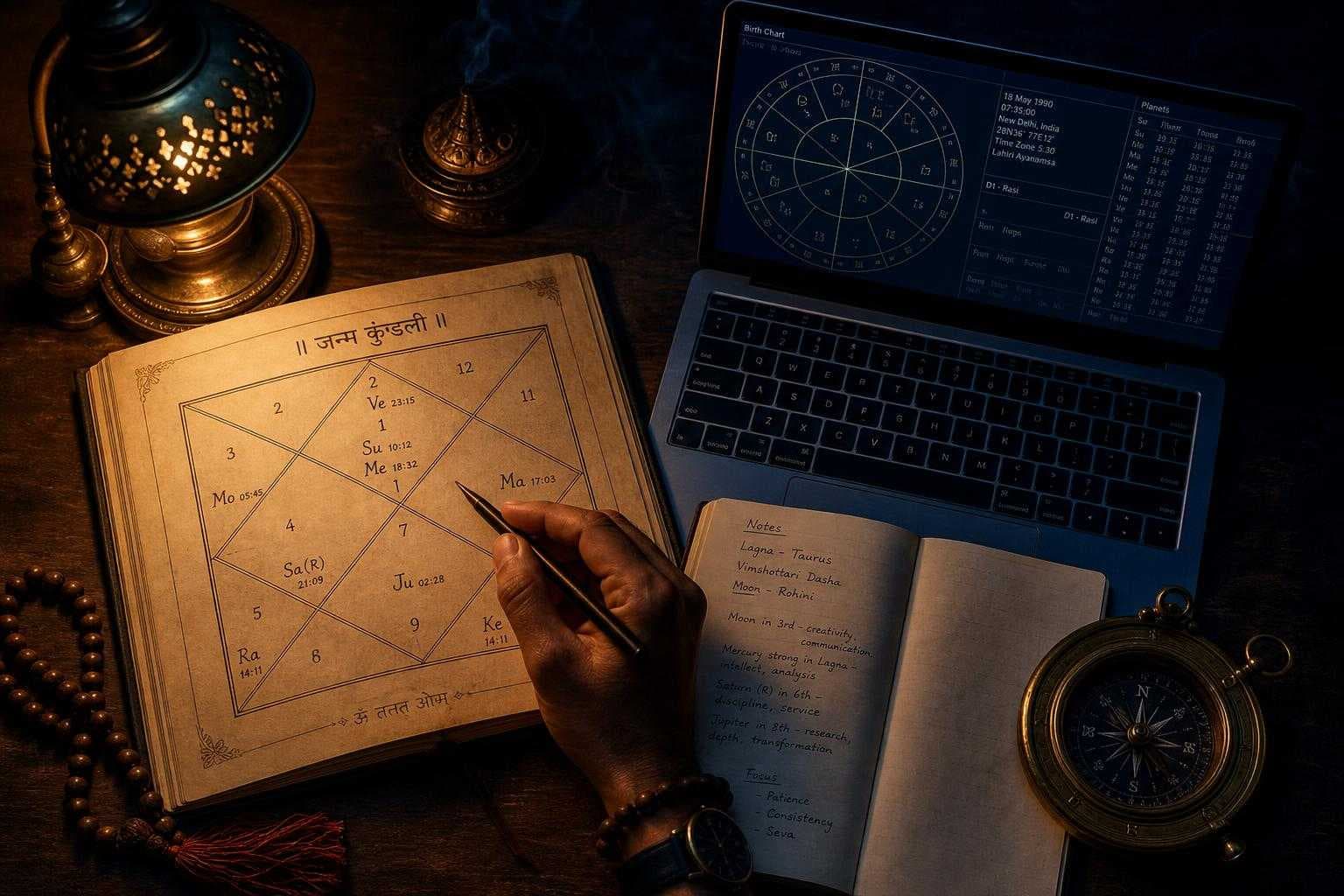
Can ChatGPT Read Your Kundali? What AI Gets Right and Dangerously Wrong About Vedic Astrology
April 22, 2026
Can ChatGPT read your Kundali? Technically, it can read the information you provide, explain the symbols, spot patterns, and turn a dense birth-chart data dump into something far less intimidating than a family WhatsApp debate about Saturn. But can it deliver a fully trustworthy Vedic astrology consultation from scratch? That is a much bigger no.
The viral promise is tempting: paste in your birth date, time, and city, then receive a cosmic life memo before your chai cools. AI is fast, fluent, and very good at making a paragraph sound like it has known your soul since the Mahabharata. That fluency is exactly why we need both curiosity and a sturdy pair of discernment sandals.
First, What Is a Kundali?
A Kundali, also called a Janam Kundali or birth chart, is a map of the sky for the time and place of birth in the Vedic astrology tradition. It tracks planets through signs, houses, lunar mansions called nakshatras, and several timing systems. A serious reading is not merely, "Mars is angry, buy red socks." It involves relationships between houses, planetary strength, aspects, divisional charts, transits, and dasha periods, meaning planetary cycles used for timing.
Your Sun sign is only one note; Moon, Rising, and the rest form the full chord.
That chord is where the complexity lives. The Moon sign may describe emotional habits. The Ascendant, or Rising sign, anchors house meanings and how the chart meets the world. The nakshatra adds a lunar-mansion layer with its own symbolism and ruler. Then a reader may check the Navamsa, a ninth-harmonic divisional chart often used for relationships, dharma, and the deeper maturation of planets. This is less like one Spotify song and more like an entire playlist with suspiciously accurate skip patterns.
Before asking AI to interpret anything, generate a verified Kundali for free so the birth data, Ascendant, nakshatra, and dasha are grounded first.
What ChatGPT Can Get Right
AI can be a helpful astrology intern. Ask it to define terms, compare interpretations, create journal prompts, or translate traditional jargon into plain English, and it can save real time. It can explain why the sixth house is often connected with routines, service, health habits, and conflict. It can outline the difference between a transit, which is a planet moving through the current sky, and a dasha, which is a longer personal timing cycle. It can also help you build a list of thoughtful questions for a professional astrologer.
It is particularly useful for structure. If you already have a chart calculated by a reputable Vedic astrology program, ChatGPT can help sort your notes: current dasha, transits to the Moon, themes in career houses, and practical experiments to try. It can turn a pile of placements into a clean reading outline instead of a celestial junk drawer.
AI is also good at offering multiple lenses. A person with a strong Saturn signature might be described through discipline, delayed gratification, responsibility, boundaries, craft, and long-game ambition. A thoughtful prompt can ask for the empowering version, the shadow version, and a grounded action plan. That is useful because astrology works best as a language for reflection, not as a remote control for your choices.
Where AI Can Go Dangerously Wrong
Here is the cosmic plot twist: sounding confident is not the same as being correct. ChatGPT can invent details, mix traditions, misread inputs, or present a generic paragraph as if it were a chart-specific revelation. In AI-land, this is often called hallucination. In astrology-land, it can look like a very polished wrong answer wearing a silk kurta.
The calculation problem comes first. Vedic astrology depends on exact birth data and methodological choices. A few minutes can shift the Ascendant near a sign boundary. Different systems may use different ayanamshas, meaning adjustments that align the zodiac with stellar positions. House systems, planetary aspects, dashas, and regional lineages can also differ. If an AI is calculating rather than interpreting a verified chart, one small error can ripple through the whole reading.
Then comes the context problem. A fourth-house theme can involve home, family, roots, property, emotional security, education, or inner peace. No language model knows which meaning matters in your Tuesday morning unless you tell it what is happening in your actual life. Even then, it may overfit: it can grab one dramatic symbolism and declare it The Answer. Real chart work needs questions, listening, and the humility to hold several possibilities at once.
There is also a safety problem. Do not let an AI astrology answer make high-stakes decisions about medicine, mental health, legal matters, pregnancy, divorce, debt, investments, or personal safety. A transit is not a diagnosis. A dasha is not a court ruling. And no planetary placement gets to veto your agency. If the advice sounds frightening, absolute, or pushes expensive remedies as an emergency purchase, close the tab with the speed of a cat hearing the vacuum cleaner.
Privacy deserves its own seat at the celestial roundtable. Birth data can be personally identifying, especially when paired with a name, location, relationship history, or private documents. OpenAI provides data controls, including options to limit whether future consumer chats are used for model improvement, and Temporary Chat options that are not saved in history or used for training. Still, the practical rule is simple: share the minimum necessary, avoid uploading sensitive documents, and review the settings of any tool before handing over your cosmic receipts.
A Better Way to Use AI for Vedic Astrology
Treat ChatGPT as a research assistant, not your guru, therapist, financial adviser, or fate vending machine. Start with a chart generated through a trusted calculator, and preserve the exact settings used: date, local birth time, birthplace, time zone, ayanamsha, and chart style. Then prompt AI with specific, bounded questions.
For example: "Using this verified sidereal chart, explain the possible themes of Saturn in my tenth house. Give three constructive expressions, three possible challenges, and five non-fatalistic questions to journal about." That prompt asks for possibilities rather than pronouncements. It also tells the machine to keep both feet on planet Earth.
Want a tiny chart snippet for your notes? Try this:
Moon in a nakshatra: emotional pattern and instinctive style.
Current dasha: longer chapter and recurring developmental themes.
Current transit: weather report, not permanent climate.
Free will: still the driver, even when Mercury is doing donuts in the parking lot.
The strongest astrology sessions usually feel collaborative. A skilled human practitioner can clarify conflicting signals, hear your lived experience, acknowledge uncertainty, and notice when a symbol is landing too heavily. AI can help you prepare for that conversation, but it cannot replace the relational intelligence of someone who knows when to pause and say, "That interpretation does not fit; let us look again."
The Bottom Line
Yes, ChatGPT can read a Kundali in the sense that it can summarize data and discuss Vedic astrological symbolism. It can be clever, useful, and surprisingly good at turning ancient techniques into approachable language. But it does not automatically calculate perfectly, verify sources, understand your lineage, or carry the ethical responsibility of a trained practitioner.
Use it for learning, organizing, brainstorming, and asking better questions. Do not use it to outsource your judgment or hand it the keys to your future. The stars may set a mood, but you are still the one making the playlist.
Try This Next
-
Make a two-column journal page: "What the chart suggests" and "What my lived experience says." Notice where symbolism genuinely helps and where it is simply a good story.
-
Before entering birth details into any AI tool, remove your full name and unnecessary personal history. Review privacy controls, or use a temporary conversation when appropriate.
-
Pick one gentle planetary remedy for the week: on Saturday, simplify one commitment, clean one neglected corner, and thank Saturn by practicing patience without turning it into a punishment.
No one can be defined by just one sign.
See for yourself, with a free horoscope.
Generate a Horoscope