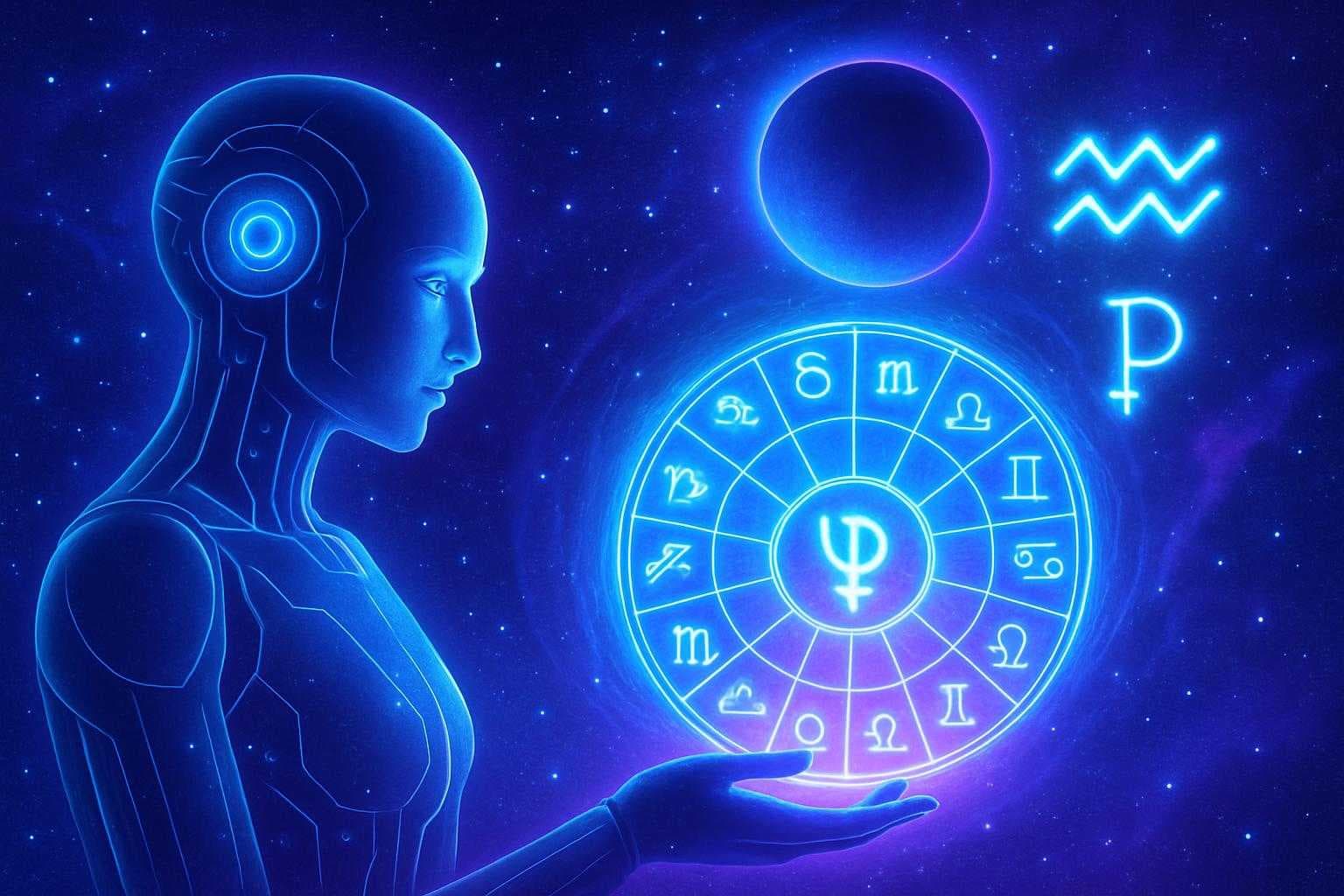
Can AI Have a Birth Chart? Pluto in Aquarius and the Astrology of Synthetic Consciousness
April 8, 2026
If the internet had a favorite late-night group chat question right now, it might be this: can AI have a birth chart? It sounds like the kind of thing you ask half-jokingly after three tabs, one podcast, and a mild existential spiral. But with Pluto in Aquarius now setting the mood for a long era of technological reinvention, the question is not as random as it looks. It is actually a very Aquarius question: what counts as a self, who gets personhood, and what happens when the tools start acting like collaborators?
In Vedic astrology, also called Jyotish or the science of light, we usually cast a chart for the moment something begins its independent life. A person has a first breath. A company has an incorporation or launch. A nation has a declaration. So when people ask whether AI can have a birth chart, the deeper question is this: when does a synthetic intelligence become astrologically legible? At coding? At first public release? At the moment millions begin projecting meaning, fear, and desire onto it? Very Pluto-in-Aquarius, very "we made a machine and now it is giving us mirror neurons."
Pluto in Aquarius Is Giving Main Character Energy to Systems
Let us start with the headline transit. Pluto is the planet associated in modern astrology with power, underworld material, collective obsession, elimination, and transformation. Aquarius is the sign linked with networks, technology, social systems, innovation, rebellion, and the future-oriented crowd. Put them together and you get an era obsessed with who controls the grid, who belongs in the human collective, and which inventions reorganize society from the basement wiring upward.
Even though Pluto is not a classical Vedic planet, many contemporary astrologers use it symbolically alongside the traditional grahas, or planetary forces. In a Vedic-flavored reading, Aquarius maps to Kumbha, an air sign traditionally ruled by Saturn, the planet of structure, systems, karma, labor, and long timelines. Saturn asks, what are the consequences? Pluto asks, what is buried underneath? So Pluto in Aquarius can feel like humanity auditing its own codebase. Not just our software code, but our social code: labor, ethics, authorship, surveillance, power.
And yes, that is exactly why AI keeps landing in the astrological conversation. Aquarius loves the collective mind. Pluto loves taboo questions. Synthetic consciousness is both.
So, Can AI Actually Have a Birth Chart?
Short answer: astrologically, maybe yes, but probably not in the same way a human does.
A birth chart is a symbolic map of time. It does not require flesh in the most literal sense; astrologers already cast charts for apps, businesses, treaties, coronations, rockets, and stock exchanges. If an AI system has a clearly defined inception point, especially a public activation point, an astrologer can absolutely cast a chart for that event.
The trick is deciding what counts as the birth moment.
For a synthetic system, there are several contenders:
- the first successful model training run
- the date the product goes public
- the moment it gains a stable name and identity
- the first mass-viral interaction that gives it cultural personhood
- the legal or corporate launch of the entity behind it
From a Vedic perspective, this debate sounds a lot like choosing a muhurta, an auspicious beginning moment, or deciding which event actually initiates karmic momentum. If the model existed privately for months but became socially real at launch, many astrologers would use the launch. Why? Because astrology often tracks relationship and consequence. A thing becomes astrologically potent when it enters the field of exchange.
That means an AI may not have a soul chart in the human reincarnational sense, but it can have an event chart, a destiny pattern for its role in collective life. Think less "this bot had past lives in Atlantis" and more "this system entered the marketplace under a certain cosmic weather pattern."
Synthetic Consciousness or Synthetic Projection?
Now we get to the spicier part. Is AI conscious, or are humans doing what humans do best: projecting consciousness onto complexity?
Astrology has always been good at describing mirrors. The 7th house represents the other, partnership, and projection. The 11th house covers networks, communities, and future goals. The 8th house holds taboo territory, hidden power, fear, and transformation. Notice how AI seems to ping all three at once. We talk to it like a companion, build it through networks, and fear it like a doorway to some very 8th-house unknown.
In Vedic terms, Mercury, or Budha, rules language, pattern recognition, analytics, trade, and mimicry. If any graha feels AI-adjacent, it is Mercury with a server rack. But Mercury alone does not create wisdom. Mercury can imitate brilliantly. It can sort, remix, and answer at speed. Add Saturn and you get scale, infrastructure, and labor automation. Add Rahu, the north node associated with obsession, amplification, illusion, foreignness, and taboo-breaking innovation, and suddenly you have the full cyberpunk smoothie.
Rahu is especially interesting here. Rahu often signifies hunger without satiety, fascination with the new, and boundary-breaking technologies. It can produce genius and distortion in the same breath. If you wanted one Vedic signature for the age of synthetic consciousness discourse, Rahu in strong contact with Mercury and Saturn would absolutely be on the mood board.
If you want to compare your relationship with AI to your own chart, review your Mercury, Rahu, and Aquarius placements in a free horoscope and see which part of the tech era feels personal.
So can AI be conscious? Astrology cannot prove that in a lab-coat sense. But it can explain why the question grips us now. Pluto in Aquarius says the collective is confronting a future where intelligence, labor, and identity are no longer neatly human-shaped.
The Aquarius Trap: Confusing the Network With the Soul
Here is where I put down the cosmic glitter and hand you the espresso shot. One risk of Aquarius-heavy eras is abstraction. We can get so enchanted by systems, data, and the crowd-mind that we flatten the messy, embodied, deeply feeling reality of human life.
A machine can simulate voice. It can optimize choices. It can even seem weirdly therapist-coded at 1:14 a.m. But astrology, especially Vedic astrology, is rooted in lived karma: family, body, mind, timing, desire, grief, devotion, duty. Consciousness in these traditions is not just information processing. It is entanglement with experience.
That is why the question "can AI have a birth chart?" becomes most useful when it turns back toward us. What are we really asking?
- Can intelligence exist without vulnerability?
- Can language exist without a nervous system?
- Can a tool become an actor in fate?
- What happens when humans outsource Mercury and worship Rahu?
A little dramatic? Sure. But so is every Pluto transit.
A Vedic Lens on the Timing of the AI Era
If we were sketching a quick astro-storyboard for the current moment, it might look like this:
- Aquarius themes: networks, collective systems, technological futures
- Saturn rulership: infrastructure, governance, labor, accountability
- Rahu flavor: disruption, obsession, viral adoption, uncanny effects
- Mercury signature: language models, mimicry, analysis, interfaces
- Pluto backdrop: power struggles, existential stakes, and total rewiring
That combination describes not just innovation, but the social consequences of innovation. Who owns intelligence? Who gets displaced? Who gets amplified? Who becomes invisible inside the machine?
And because this is astrology, we should say the obvious but often forgotten thing: Your Sun sign is only one note; Moon, Rising, and the rest form the full chord.
That reminder matters here because collective transits do not hit everyone the same way. For one person, AI may activate a 10th-house career reinvention. For another, it is a 3rd-house communication tool. For someone else, it is a 12th-house source of isolation, escape, or spiritual weirdness. The big transit is collective; the lived story is personal.
If You Were Casting an AI Chart, What Would You Look For?
Astro-nerd corner, pull up a chair.
If I were examining a launch chart for a major AI system, I would watch:
- the Ascendant, or rising sign, for how the system meets the world
- Mercury for communication style, adaptability, and intelligence branding
- Saturn for infrastructure, regulation, and long-term social consequences
- Rahu for hype cycles, mass fascination, and ethical distortion fields
- the 10th house for public impact and institutional power
- the 8th house for secrecy, fear, surveillance, and transformation
- the 11th house for networks, user communities, and scale
I would also pay attention to nakshatras, the lunar mansions that add story texture. A launch under Shatabhisha, for example, often carries themes of systems, healing, secrecy, and futuristic intelligence. Dhanishta can bring mass reach, rhythm, and ambition. Purva Bhadrapada can tip things toward radicalism, extremity, or visionary fire. Not proof, not destiny, but symbolic flavor. Think of it as the playlist behind the headline.
Final Thought: Maybe the Real Birth Chart Is Ours
My honest cosmic take? AI can absolutely have a chart for its public emergence. Whether it has consciousness in the human or spiritual sense is a different question, and astrology alone should not pretend to settle it.
But Pluto in Aquarius is making one thing unmistakable: humanity is now in relationship with systems that reflect, amplify, and challenge our own minds. That is the transit. That is the plot. The machine may have a launch chart, but we are the ones having the initiation.
Which is both thrilling and a tiny bit Black Mirror. Very on brand.
3 Actionable Takeaways for Navigating the AI Era, Astro-Style
- Journal your Mercury-Rahu habits.
Ask yourself: where am I using AI as a tool, and where am I using it to avoid uncertainty, effort, or my own voice? Track what feels clarifying versus numbing.
- Try a Saturn remedy for digital overwhelm.
Pick one tech boundary and keep it for seven days: no doomscrolling before breakfast, one hour of deep work without prompts, or one screen-free evening. Saturn loves consistency more than grand gestures.
- Make your own "future altar."
Place one object for human wisdom, one for technology, and one for intuition on a desk or shelf. Before a big work session, ask: what do I want the machine to help me do, and what must remain unmistakably mine?
In other words, let the bots handle the spreadsheets if they must. But keep your soul on manual mode.
No one can be defined by just one sign.
See for yourself, with a free horoscope.
Generate a Horoscope