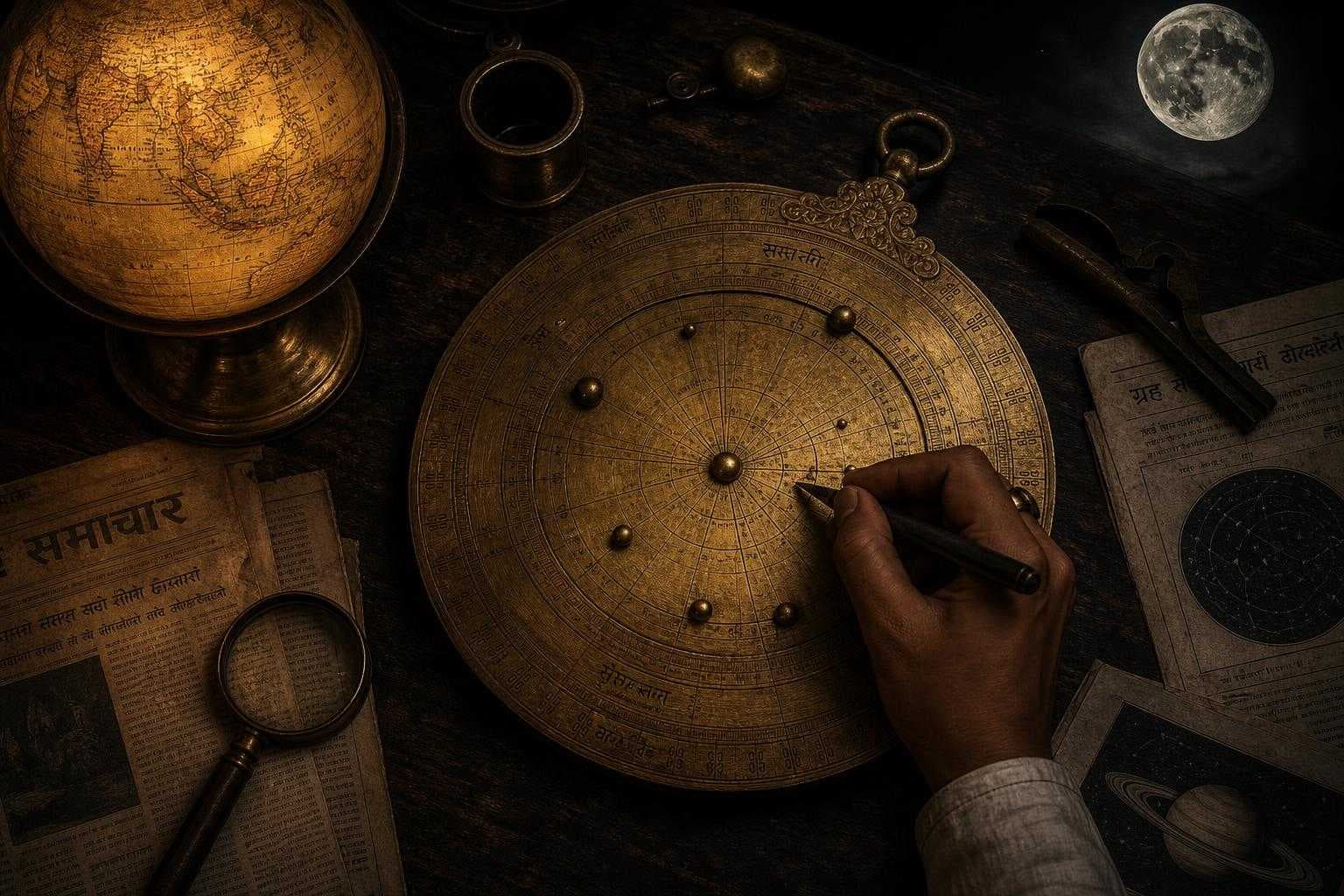
Astrologers in India Predicted These World Events: Coincidence or Something Else?
July 10, 2026
When a major world event hits, the internet suddenly becomes a time machine. Screenshots fly, old videos resurface, and somebody inevitably posts: "An astrologer called this months ago." Cue the raised eyebrow, the goosebumps, and the comment section duel between "the stars know" and "that is hindsight doing CrossFit."
The big question behind all the viral clips is deliciously simple: when astrologers in India predicted these world events, was it coincidence or something else?
Vedic astrology, also called Jyotish or the "science of light," has never limited itself to love-life readings and whether your ex will text during Mercury retrograde. Its older political and collective branch, Mundane Astrology, studies nations, leaders, weather patterns, markets, public health, and major social shifts. In other words: less "Will I meet someone cute at brunch?" and more "Why does the whole group chat feel like it is living through a historical plot twist?"
To separate collective weather from your personal timing, check your current dasha and key transits in a free horoscope before treating any world forecast as your own forecast.
The Predictions That Keep Getting Reposted
The most discussed example is the run-up to 2020. Before the COVID-19 pandemic reshaped everyday life, a number of astrologers in India and elsewhere described 2020 as a period of global disruption, economic strain, public anxiety, and dramatic institutional change. Some pointed to the heavy Capricorn lineup involving Saturn, Jupiter, and other slow-moving planetary influences as a signal that systems tied to government, work, authority, and the economy would be tested.
That is not the same as predicting a specific virus, a precise start date, or the exact shape of lockdown life. It is important to keep that distinction bright and blinking like a neon sign. Broad forecasts of upheaval are different from saying, "A respiratory pandemic will spread worldwide and make sourdough starter a personality trait."
Still, the symbolism got people's attention. In Jyotish, Saturn is linked with pressure, limits, labor, systems, delay, and consequences. Capricorn is connected with hierarchy, institutions, governance, infrastructure, and ambition. Add Rahu, the north lunar node associated with amplification, obsession, confusion, and unusual disruptions, and astrologers saw a climate where the ordinary rules might wobble.
Later, people also revisited forecasts about economic volatility, geopolitical tension, technology disruption, and public unrest. Some were impressively specific. Others were broad enough to fit several possible outcomes. That does not make every astrologer a cosmic fraud or every forecast a divine download. It means we need to examine the receipts with both curiosity and common sense.
What Mundane Astrology Actually Looks At
A personal birth chart begins with a person's birth time and place. Mundane Astrology begins with a larger entity: a country's founding chart, an election chart, a market opening chart, or the chart for a major event. Astrologers then watch transits, or current planetary movements, against that chart.
Here is the quick cosmic cheat sheet:
- Saturn: restrictions, accountability, long-term structures, collective hardship, rebuilding.
- Jupiter: growth, law, education, optimism, expansion, and sometimes excess.
- Mars: conflict, heat, military action, urgency, accidents, and agitation.
- Rahu and Ketu: the lunar nodes, often read as disruption, karmic turning points, hidden forces, obsession, detachment, and reversals.
- Eclipses: accelerators. They do not "cause" every headline, but astrologers often treat them as periods when dormant themes become visible fast.
Then there are nakshatras, the 27 lunar mansions used in Vedic astrology. Think of them as finer-grained neighborhoods within the zodiac. A planet's sign tells you the general vibe; its nakshatra adds a more specific storyline. For a mundane astrologer, that can sharpen a forecast around themes such as storms, conflict, leadership shakeups, mass communication, medicine, or migration.
It is a symbolic language, not a meteorological app and not a replacement for scientists, public-health experts, or financial professionals. The stars may offer a framework for reflection; they do not excuse skipping the actual data.
Why Some Calls Feel Spooky Accurate
There are a few reasons a prediction can seem uncannily right.
First, skilled astrologers are often excellent pattern readers. They may combine planetary cycles with history, economics, politics, and human behavior. Saturn returns to similar regions of the sky on a long rhythm. Eclipses repeat in families. Jupiter and Saturn form cycles that astrologers compare with prior political and economic eras. This does not prove causation, but it can create a compelling map for tracking recurring pressure points.
Second, language matters. "A period of instability affecting public systems" can describe many events: a recession, a conflict, a public-health crisis, labor unrest, or a government scandal. If a forecast is too flexible, it can hit after the fact without having truly risked being wrong.
Third, humans are meaning-making machines. We remember the prediction that landed and forget the fifteen that did not. Psychologists call this confirmation bias. Astrologers have their own version of this problem, too. A chart can contain many symbols, and it is easy to spotlight the one that suddenly looks prophetic once the headline already exists.
The fairest standard is simple: timestamp the forecast, preserve the original wording, note the date range, and count misses along with hits. No cosmic selective editing. No deleting the "definitely by September" post when September comes and goes. The universe may be mysterious, but your prediction archive should not be.
Coincidence, Symbolism, or a Different Kind of Forecasting?
Maybe the answer is not one dramatic drumroll. Astrology may work best for some people as a symbolic weather report rather than a literal crystal ball. A weather report can tell you conditions are stormy; it cannot tell you exactly which puddle will ruin your sneakers.
In that spirit, a strong mundane forecast might say: "Watch institutions, public confidence, health systems, supply chains, and markets during this planetary pileup." That is useful if it inspires preparedness, flexibility, and compassion. It becomes less useful when it turns into panic bait, fatalistic doom-scrolling, or a substitute for evidence-based decisions.
Your Sun sign is only one note; Moon, Rising, and the rest form the full chord. The same is true of collective astrology: one transit rarely tells the whole story. Serious Jyotish practitioners look for multiple indicators, timing periods called dashas or planetary cycles, and the specific chart being studied. A single scary Saturn transit is not a permission slip to declare the apocalypse before breakfast.
The Real Test Is How We Use the Story
The fascination around astrologers in India predicting world events says something meaningful even if you remain fully skeptical. During uncertainty, people want patterns. We want a language for the feeling that the ground is moving beneath us. Astrology gives many people a mythic vocabulary for that feeling: Saturn says build stronger structures. Rahu says beware the frenzy. Jupiter says seek wise guidance and a larger perspective.
That is a much healthier use of astrology than treating every transit like a spoiler alert for your life. The chart is a conversation starter, not handcuffs. And the best astrologers do not ask you to surrender your judgment. They invite you to strengthen it.
So, coincidence or something else? Possibly a mix of careful archival work, broad symbolic interpretation, real pattern recognition, chance, and the human need to connect events into a story. The cosmic answer may be less satisfying than a clean yes or no. But it is also more interesting.
Three Grounded Ways to Work With Big Cosmic Headlines
-
Start a prediction receipt journal. When you hear a major forecast, write down the exact claim, source, date, time frame, and what would count as a miss. Revisit it later with honesty. This is your antidote to astrology's greatest enemy: convenient memory.
-
Do a Saturn readiness ritual. On a Saturday, make one practical move that future-you will thank you for: update your emergency contacts, pay down a small debt, back up your files, or schedule a health checkup. Saturn loves boring competence. Honestly, it is the original adulting influencer.
-
Use news astrology as a reflection prompt, not a trading strategy. Ask: "Where do I need more discernment, resilience, or community support right now?" Then pair the answer with reliable reporting and qualified expert advice. Mysticism and good judgment can absolutely share a table.
No one can be defined by just one sign.
See for yourself, with a free horoscope.
Generate a Horoscope