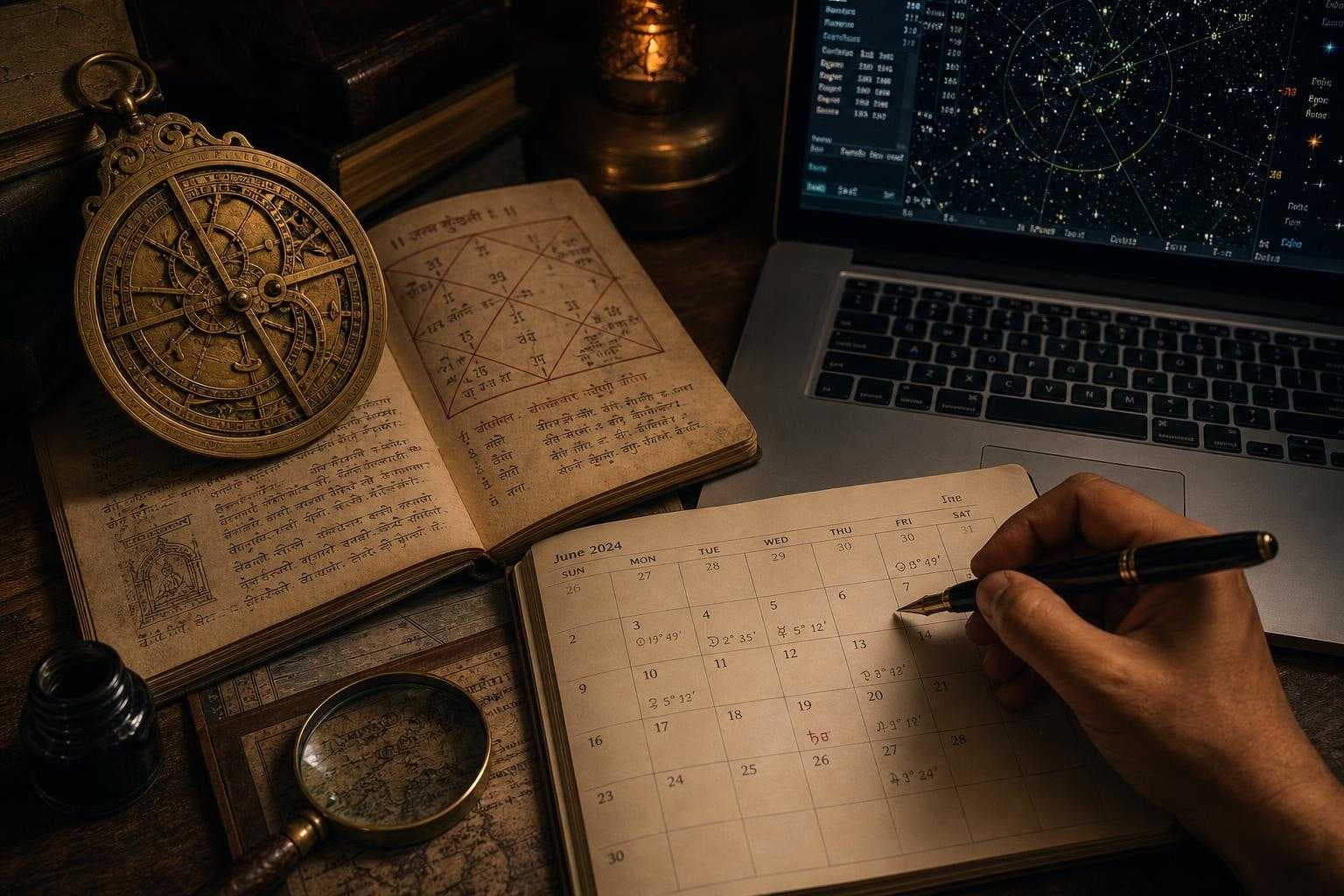
AI Astrologers vs Human Jyotishis: Why Prashna and Muhurta Still Need a Human Mind
June 30, 2026
The astrology group chat has entered its sci-fi era. One person is uploading a birth chart to an AI tool, another is asking a chatbot whether Tuesday at 2:17 p.m. is good for a job launch, and someone else is typing, "Should I text my ex tonight?" with the urgency of a season finale cliffhanger. AI astrologers are fast, available at 3 a.m., and never need chai breaks. That is useful. But when it comes to Prashna and Muhurta, two of Jyotish's most context-heavy arts, speed is not the same as wisdom.
First, What Are Prashna and Muhurta?
Prashna means "question" in Sanskrit. It is a branch of Vedic astrology that reads the chart for the precise moment a sincere question is asked. Instead of beginning with a birth chart, the Jyotishi studies the cosmic weather around the question itself: the rising sign, the Moon, house rulers, planetary dignity, aspects, and sometimes the relevant nakshatra, or lunar mansion.
Muhurta means "auspicious timing." It is the art of selecting a supportive moment to begin something: a wedding, business launch, surgery, move, contract signing, naming ceremony, or even the first day of a major project. Think of it as celestial event planning, with fewer color swatches and more Moon phases.
Both practices involve calculation. AI can absolutely help there. It can list planetary positions, compare dates, summarize traditional rules, create checklists, and catch the kind of arithmetic slip that makes Mercury retrograde feel personally employed by your spreadsheet. But calculation is the beginning of the reading, not the reading itself.
Before using any tool for sacred timing, generate a free horoscope to ground the Prashna or Muhurta question in accurate chart details.
AI Is a Fast Assistant, Not a Seated Jyotishi
An AI astrologer can be excellent at the backstage work. Give it reliable chart data and a clear method, and it can sort transits, identify a void-like gap in your schedule, explain why the Moon matters in electional astrology, or draft questions to bring to a consultation. It can also translate dense astrological language into something friendlier than "the dispositor is afflicted under a malefic influence." Bless.
Yet AI operates through patterns in language and data. A human Jyotishi operates through technique plus discernment. That distinction matters most when the question is emotionally loaded, ethically complicated, or badly framed.
Suppose someone asks, "Will my partner leave me?" An AI might jump straight into prediction mode, because it is responding to the words on the screen. A wise human astrologer hears the fear beneath the wording. They may slow down, ask what has happened, clarify whether there is danger or uncertainty, and shift the consultation toward agency: communication, boundaries, support, timing, and the choices the client can actually make.
That is not dodging the chart. That is reading the chart like a human being.
Your Sun sign is only one note; Moon, Rising, and the rest form the full chord.
Why Prashna Needs Presence
Prashna is not simply "make a chart when someone asks a question." Traditional practitioners often treat the question as a living event. Is the person serious? Have they asked the same question seventeen times in seven apps? Are they asking from panic, curiosity, grief, or a true turning point? Has the question ripened enough to be asked?
This is where a human mind earns its seat at the table.
A seasoned Jyotishi can notice when the stated question is a decoy. "Will I get the job?" may really mean, "Do I believe I deserve more money?" "Should I relocate?" may hide a caregiving dilemma, a relationship issue, or burnout. The chart can show themes, but context tells us which symbolic thread matters now.
Prashna also requires interpretation of ambiguity. The Moon may describe the emotional pulse of the question. The ascendant, or rising sign, can show the asker and their capacity to act. The seventh house may point to the other party, the tenth to career, the fourth to home, and so on. But no placement arrives with a tiny subtitle saying, "This is definitely about your manager named Chris." A human reader weighs the symbols against the lived story, asks better questions, and resists overclaiming.
In other words: Prashna is not a cosmic Magic 8 Ball. It is closer to an intelligent conversation with the moment.
Why Muhurta Is More Than Finding a Green Light
Muhurta can look deceptively simple online. Avoid certain days. Choose a waxing Moon. Pick a favorable nakshatra. Do the thing. Easy, right? That is how you end up choosing a technically lovely launch time at 4:42 a.m. when your customers, team, lawyer, and web developer are asleep.
A human Jyotishi asks what success means for this event. Is the goal visibility, longevity, cash flow, harmony, medical recovery, legal stability, or emotional ease? Different aims emphasize different houses and planetary qualities.
For a business launch, the tenth house of public work, the eleventh house of gains and networks, Mercury for commerce, and the Moon for public response may deserve special attention. For a marriage ceremony, the seventh house of partnership, Venus, Jupiter, and the condition of the Moon might carry more weight. For a home purchase, the fourth house, its ruler, and the practical reality of financing become central.
Then comes the part no generic algorithm can fully own: trade-offs. Perfect timing does not exist in the human world. The best date may conflict with a visa deadline, hospital availability, a family elder's travel plans, or a lease expiration. An ethical Jyotishi does not declare the entire project doomed because Venus is having a dramatic day. They help find the most supportive workable window.
That is the real magic of Muhurta: not perfection, but wise alignment.
The Human Skill Is Ethical Editing
Astrology has power because people bring real hopes, fears, money, relationships, and identity to the reading. That calls for ethical editing: knowing what not to say, what to soften, what to question, and when to encourage practical support beyond astrology.
A human Jyotishi can recognize when a client is outsourcing every decision to a chart. They can say, kindly, "Let us use this timing as information, not handcuffs." They can refuse to intensify paranoia, avoid absolute claims about health or death, and remind a client that another person's autonomy is not an object to be predicted into submission.
AI can be prompted to use responsible language, and it should be. But the warmth of accountability is different when a trained person is listening, responding, and taking responsibility for the impact of their words. The goal is not to make astrology less mystical. It is to make it more humane.
The Best Future Is Collaboration, Not Robot vs. Rishi
The meme version is "AI replaces the astrologer." The more interesting version is "AI becomes the Jyotishi's extremely caffeinated research assistant." Let AI calculate, organize, generate comparison tables, and translate technical vocabulary. Let the human practitioner verify inputs, choose the method, understand lineage, hold nuance, and speak to the actual person asking.
Use AI for the map. Use a human Jyotishi for the terrain.
Three Grounded Takeaways
-
Before asking a Prashna question, journal for five minutes: "What am I truly asking, and what decision is mine to make?" A clearer question creates a clearer consultation.
-
For Muhurta, define success in one sentence before selecting a date. Try: "This launch needs steady income and a reliable audience," not just "Make it lucky."
-
Give your nervous system a small Moon remedy before any major choice: drink water, step outside for two minutes, and wait one sleep cycle before treating an astrological answer as final. The cosmos can offer timing; your human wisdom still gets the last word.
No one can be defined by just one sign.
See for yourself, with a free horoscope.
Generate a Horoscope